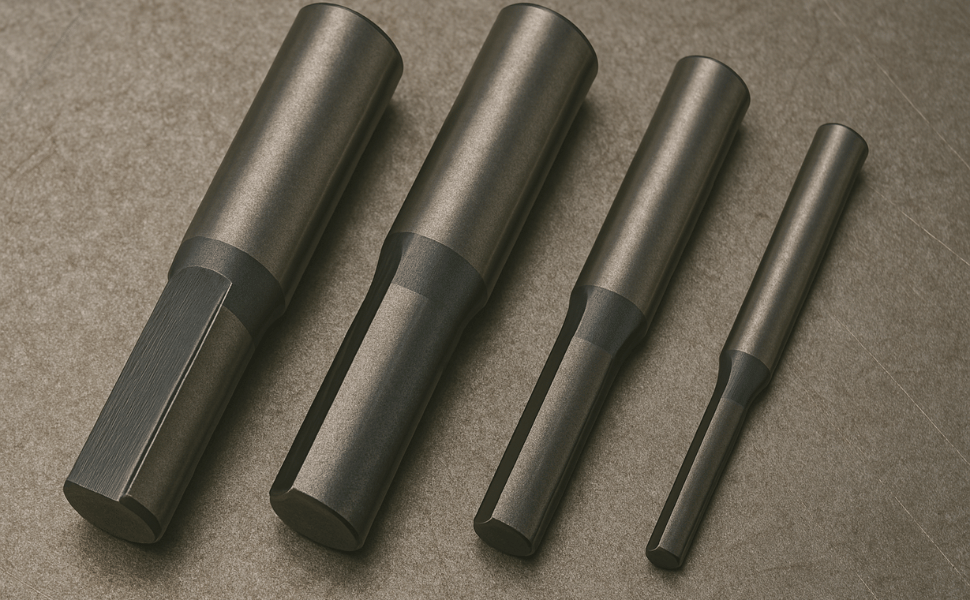
- End mills (middle row in image) are those tools which have cutting teeth at one end, as well as on the sides. The words end mill are generally used to refer to flat bottomed cutters, but also include rounded cutters (referred to as ball nosed) and radiused cutters (referred to as bull nose, or torus). They are usually made from high speed steel or cemented carbide, and have one or more flutes. They are the most common tool used in a vertical mill.
- Roughing end mill
- Roughing end mills quickly remove large amounts of material. This kind of end mill utilizes a wavy tooth form cut on the periphery. These wavy teeth act as many successive cutting edges producing many small chips. This results in a relatively rough surface finish, but the swarf takes the form of short thin sections and is more manageable than a thicker more ribbon-like section, resulting in smaller chips that are easier to clear. During cutting, multiple teeth are in simultaneous contact with the workpiece, reducing chatter and vibration. Rapid stock removal with heavy milling cuts is sometimes called hogging. Roughing end mills are also sometimes known as “rippa” or “ripper” cutters.